


Maningrida Arts and Culture
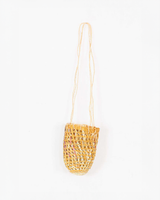
Lorna Jin-gubarrangunyja (Dec) — 'Burlupurr - large dillybag' 612-25, Maningrida Arts and Culture
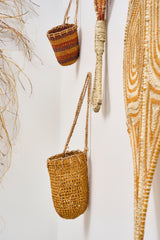
Burlupurr, or dilly bag, is a large woven collecting basket. These large bags are often made from the vine 'Malasia scandens', a strong pliable plant which grows along the floor and into the canopy of monsoon vine thickets. The bags are used to collect any kind of large numbers of heavy foods such as fish caught in conical fish traps or large collections of yams.
They can also be made from Pandanus spiralis, a plant which grows in many areas of Arnhem Land. These dilly bags are a tightly woven collecting basket, very finely made. These dilly bags are often used to collect sugarbag, the native honey.
As well as being of practical use, dilly bags are also of religious significance to Arnhem Land people. Dilly bags are said to be totemic objects and associated with particular sites in the landscape.
—
Lorna Jin-gubarrangunyja (Dec)
Skin Name: Galijan/ Language: Burarra (Martay) / Moiety:Jowunga / Country: Martang -Ayirra
Lorna Jin-gubarrangunyja was born in 1952. She is a Burarra fibre artist, living at Yilan outstation, who has been regularly producing artworks for Maningrida Arts and Culture since the 1980s. She was often making colourful twined pandanus dilly bags, mats, string bags and baby shade covers. In 1995, she participated in a landmarks touring fibre exhibition Maningirda : the language of weaving which featured two fish traps by Burarra male artist Raymond Walabirr (now deceased).
This exhibition aimed at repositioning fibre production into the fine art category. It succeeded at some levels but it failed in changing the overall perception of fibre art by the general public or commercial galleries. For example, no one offered to do a commercial fibre show dedicated to the production of mats or baskets after this major exhibition. In 2002, Jin-gubarrangunyja made her first fish trap, learning this technique from her husband George Ganyjibala, as traditionally men were making fish traps. She now uses fish trap forms as the basis for sculptural works of art. Jin-gubarrangunyja innovates with forms and colours, using diverse weaving techniques to make sculptures that have their origin in the traditional fish trap techniques. The utilitarian purpose of the fish trap is no longer the main focus of her production. She re-explores traditional techniques to create contemporary and innovative works of art and works with diverse fibre such as pandanus (pandanus spiralis ) that she dyes with natural colors, jungle vine (Malaisia scandens ) and grass (cyperus javanicus ).
A year after her first attempt at making a fish trap, in 2003, Jin-gubarrangunyja won the Wandjuk Marika Award at the 20th Telstra National Aboriginal and Torres Strait Islander Art Award (NATSIAA) with a colourful pandanus fish trap. She is nowrecognised as a leading fibre artist and participates regularly in group exhibitions in commercial galleries. Interestingly enough, her fish trap production has generated an interest in her dilly bags that are now exhibited along with her fish trap forms.
Through innovation and working on a bigger scale, Jin-gubarrangunyja has established herself as a successful fibre artist, gaining public recognition for her work and a financial income comparable with artists working in other media. She has also inspired other Maningrida artists to make fish traps. Now, more than 20 artists make fish trap forms on a regular basis, including three men who have switched from painting to fibre production in the last two years as they have realised that they were more succesful fibre artists than painters.
—
Maningrida Arts and Culture x Craft
July 2 – August 29 2026
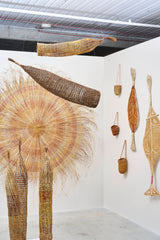
'Manngarre/Mannga brings together fifteen dynamic artists in a landmark collaboration between the Maningrida Arts and Culture and Craft Victoria. This exhibition celebrates fibre works that are more than objects; they carry cultural knowledge, storytelling, and innovation. Each piece reflects generations of practice, individual creativity, and the natural materials of bush and jungle Country, deeply tied to the weaver’s clan estate.
Maningrida Arts & Culture is one of Australia's oldest Aboriginal community-controlled art and culture centres, dating back to 1963. Located in central west Arnhem Land, it supports artists from 12 language groups, 32 homelands and 110 clans.
Manngarre, meaning jungle in Kuninjku language, and Mannga its equivalent in Burarra/Gun-nartpa respectively, is an exhibition of intricately woven works by women fibre artists of the Maningrida region.
Maureen Ali / Freda Ali / Cecille Baker / Louwa Bardaluna / Bonnie Burarngarra / Dorothy Bunibuni / Nola Garrba / Lorna Jin-gubarrangunyja (Dec) / Jocelyn Koyole / Samantha Malkudja / Sylvia Marrgawaidj / Annalese Morris / Basma Nulla / Jennifer Prudence / Philomena Wilson
Read more about the exhibition here:
Material: Pandanus (Pandanus Spiralis) with natural dyes
Dimensions: 14 x 21cm
Cat. no: 612-25
Please note when purchasing, exhibition works are to be collected when exhibition closes.
Shipping costs may be estimates. Please feel free to contact shop@craft.org.au who will be available to provide an Art Courier quote or shipping costs for larger items.