


Maningrida Arts and Culture
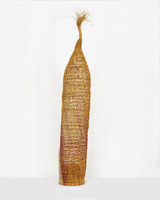
Maureen Ali — 'An-gujechiya (Fish Trap)' 293-26, Maningrida Arts and Culture
To make fish traps and fish net fences artists firstly get vine (mirlarl) from the jungle and they put it in water for one night to make it soft. Next they start weaving it; they make rings for the inside to keep the fish trap’s shape. Artists work for three or four weeks on the fish trap. They also make string from kurrajong (burdaga) to attach the hibiscus (bardainy) rings and to tie the conical end of the fish trap. This fish trap is used in saltwater and freshwater. People also use fish net fences called mun-dirra.
A long time ago they would put the mun-dirra across rivers and creeks. In the middle they would place the an-gujechiya. They also used small things like sticks, rocks, mud and grass to block the fish from going through. People would then catch fish like saltwater barramundi rajarra, freshwater barramundi (janambal), small black freshwater catfish (buliya), bonefish (anguwirrpiya), and sand bass (dalakan) in these fish traps.
—
Maureen Ali
Skin Name: Gotjan / Language: Burarra (Martay) / Clan: Gamarl / Moiety:Yirrchinga
Maureen Ali learned to weave under the guidance of her sister Bonny Burarn.garra, a highly skilled fibre artist who has exhibited in commercial galleries around Australia since the 1990s. She also learned from her watching her mother, leading fibre artist Lorna Jin-gubarrangunyja, who won the Wandjuk Marika Award at the 20th Telstra National Aboriginal and Torres Strait Islander Art Award (NATSIAA) in 2013 with a colourful pandanus fish trap.
Maureen has been practicing since 2006. She is Burarra, one of the east-side language groups who specialise in the customary conical dilly bags, woven string bags and mats. She is particularly renowned for the use of mirlarl, (malaisia scandens), a type of vine that grows in the coastal jungle. The use of this vine to manufacture fish traps, barriers and large strong dillybags is unique to this region.
—
Maningrida Arts and Culture x Craft
July 2 – August 29 2026
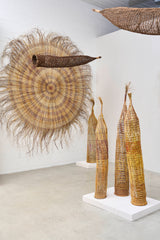
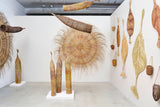
'Manngarre/Mannga brings together fifteen dynamic artists in a landmark collaboration between the Maningrida Arts and Culture and Craft Victoria. This exhibition celebrates fibre works that are more than objects; they carry cultural knowledge, storytelling, and innovation. Each piece reflects generations of practice, individual creativity, and the natural materials of bush and jungle Country, deeply tied to the weaver’s clan estate.
Maningrida Arts & Culture is one of Australia's oldest Aboriginal community-controlled art and culture centres, dating back to 1963. Located in central west Arnhem Land, it supports artists from 12 language groups, 32 homelands and 110 clans.
Manngarre, meaning jungle in Kuninjku language, and Mannga its equivalent in Burarra/Gun-nartpa respectively, is an exhibition of intricately woven works by women fibre artists of the Maningrida region.
Maureen Ali / Freda Ali / Cecille Baker / Louwa Bardaluna / Bonnie Burarngarra / Dorothy Bunibuni / Nola Garrba / Lorna Jin-gubarrangunyja (Dec) / Jocelyn Koyole / Samantha Malkudja / Sylvia Marrgawaidj / Annalese Morris / Basma Nulla / Jennifer Prudence / Philomena Wilson
Read more about the exhibition here:
Material: Pandanus (Pandanus Spiralis), Sand Palm (Livistonia Humilis) and Kurrajong (Brachychiton Populneus)with natural dyes
Dimensions: 143 x 22 x 22cm
Cat. no: 293-26
Please note when purchasing, exhibition works are to be collected when exhibition closes.
Shipping costs may be estimates. Please feel free to contact shop@craft.org.au who will be available to provide an Art Courier quote or shipping costs for larger items.